Don’t mock the Victorian Do-Gooders

I’m very much enjoying Ian Hislop’s “Age of the Do-Gooders” on BBC2. You sense Ian is always wanting to mock, but instead is finding himself deeply impressed by the courage and committment of his subjects.

Next week he’ll be talking about sex and drink and the reformers who did their best to change patterns of behaviour within society.
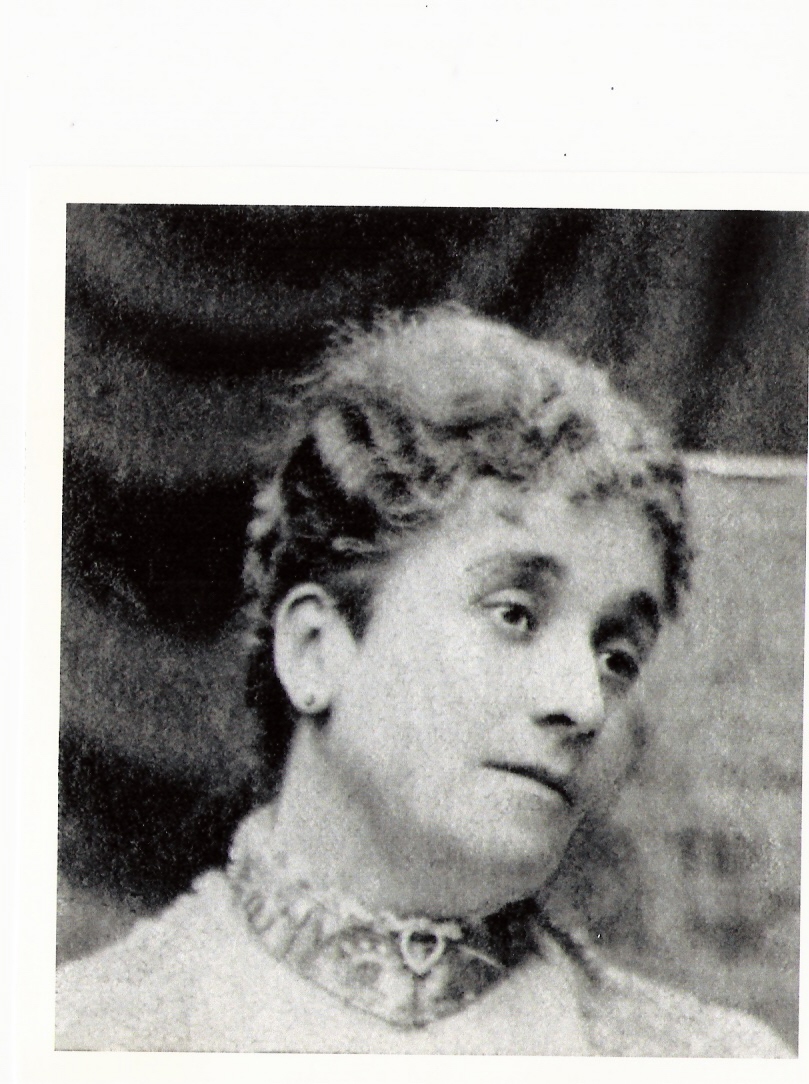
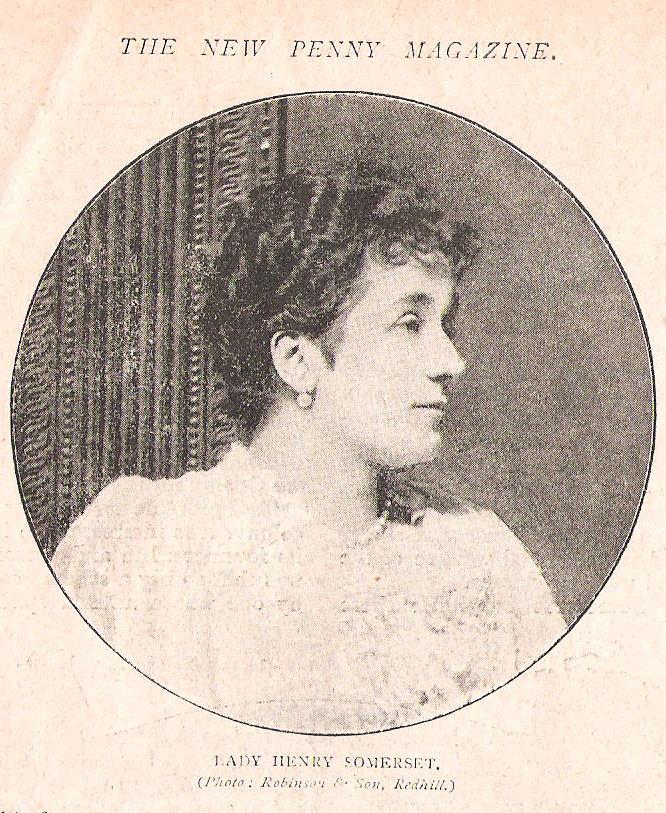
Lady Henry Somerset was a leading figure in this area.

On a national and international scale, as president of the British Women’s Temperance Movement, she promoted the cause of temperance throughout the land. To her this meant trying to persuade the government and local authorities not to issue so many liquor licences, to make it easier for people to “do good”, harder to do harm, to themselves or others. Unlike her colleagues in America, she did not favour prohibition. She was not against the idea of people enjoying a drink in moderation, but she felt alcohol and drug abuse was the cause of many social problems. It was too cheap and too readily available and so an easy escape route from loneliness, poverty and depression.

She recognised that, amongst the working class, there was a vicious circle. Social deprivation led to the urge for oblivion through drink or drugs but alcohol and drug abuse led to social degradation.

She had first hand experience of the harm drink could do. One of her own aristocratic friends had committed suicide, having become addicted to drink. She also went out into the town and city streets on cold dark nights and witnessed for herself the damage excessive drinking could do. Bye Street in Ledbury, a market town just a few miles from her stately home of Eastnor Castle, was notorious for its drink-filled squalor. Whitechapel and the East End of London came under her close scrutiny. She preached and she led by example, taking the total abstinence pledge herself.

But for Lady Henry, words were not enough. In any small way she could, she set about making a difference. In 1894 she bought land at Duxhurst, just south of another of her family’s estates at Reigate in Surrey and there she established her village for the care and reform of inebriate women.

Duxhurst was an incredible enterprise. Upper class ladies and the celebrities of the day who had fallen into alcohol or drug abuse, stayed at the Manor House there. Middle class women had their own Hope Cottage and contributed towards their own costs.

The working class women, many of whom were rescued from the courts and sent to Duxhurst as an alternative to prison, were housed in simple cottages around a village green – a world away from the slums of their old life. All were encourgaed to participate in the work of the village – on the farm, in the lavender fields or in the greenhouses, or working on looms or in the pottery. Lady Henry was a great believer in occupational therapy and recognised that “the moral effect of being able to create something of beauty is curiously apparent”. She ensured the physical needs of all the patients were attended to as a priority. Each new resident spent at least a few days being assessed and treated in the small hospital she had built on site before being allocated to one of the cottages, under the charge of the “right nurse Sister”.

“One may be especially good with young women, another may best understand the middle-aged. A third may have a genius for the Bohemian type, a fourth may give all her sympathies to the conventional,” she wrote in Beauty for Ashes, her book about the Duxhurst project, showing a deep understanding of human nature.

Lady Henry Somerset was driven by her own religious convictions and by an empathy with women who were scorned by society because of their drink problem and subsequent behaviour. This empathy was borne out of her own unhappy marital experiences and the shame she herself had felt at being ostracised by some of her peers because she had challenged her husband’s behaviour and sought (and won) custody of their child. She had once had to flee down the backstairs of her sister’s house because her sister’s mother in law, the Duchess of Bedford, refused to acknowledge her, a woman who had “created a new sin” and “dared to mention something which was only mentioned in the Bible”. She believed that this bitter experience gave her a unique insight into the plight of others. She understood their loneliness and depression.
Lady Henry may not have appreciated the title of “do-gooder”. She mocked many of her class for their token efforts and lack of imagination.
“Only those who can change places, and find themselves in the position of the sufferer or sinner, have the power to help or comfort them”, she believed.

Posted in Lady Henry, Temperance | Tagged , , , , , , | 4 Comments

Lady Henry Somerset and WT Stead

Lady Henry Somerset was the subject of a character sketch by the reknowned, some would call notorious, journalist WT Stead, printed in the Review of reviews in June 1893.

Stead has been described as “an important contributor to the birth of today’s tabloid journalism” and when one considers the case which made him notorious you can see why.

Born in 1849, Stead became the youngest newspapaer editor in the country when aged 22, he was appointed editor of the “Northern Echo” in Darlington. Under Stead’s stewardship, this provincial newspaper became a leading voice promoting the causes of liberalism, equality and social justice.
He then went to work on the Pall Mall Gazette, becoming its editor in 1883. His attacks on slum housing and lack of funding for the navy are reputed to have lead to legal reforms. Then in 1885, he scandalised his readers with a piece entitled “The Maiden Tribute of Modern Babylon”, exposing the trade in child prostitution. But as part of his expose, he had actually staged the purchase of a young girl and ironically found himself the first victim of the law amendment his article had prompted. He was imprisoned for 3 months for abduction and indecent assault. But the age of consent for females was raised from 13 to 16.
The scandal of his imprisonment lost him many friends, but Lady Henry Somerset remained loyal.
An excellent website provides further information about Stead.
The W.T. Stead Resource Site

In his character sketch, WT Stead praises Lady Henry’s work but sounds a warning – that she is in danger of allowing herself to become too “put upon”; to allow “the frittering away of her strength by endless calls for all manner of trivial duties. He says that “As commander in chief she must not allow herself to do sentry-go on every platform throughout the country.”
This accurate observation was, however, not heeded by Lady Henry herself. She embraced ever more causes, to the detriment of her own health and, argued some of the women of the BWTA, the temperance movement itself.

Posted in Lady Henry, Temperance | Tagged , , | Leave a comment

Talk at Reigate Priory Park Pavilion Tuesday 7th Sep 7pm

I am giving an illustrated talk about Lady Henry Somerset at Reigate Priory Park Pavilion on Tuesday 7th September at 7pm.

The event is free but due to space constraints, please book your place by emailing PrioryPark@ reigate-banstead.gov.uk

Come along to find out more about the fascinating life of one of Reigate’s most notable women; a woman who gave so much of herself to make the lives of others better.

Discover how she lived and used Reigate Priory and the Park and how she involved herself in local life.
Discover how she set up her village for inebriate women just a few miles south of Reigate.

I shall have copies of my new biography of Lady Henry – A Talent for Humanity – for sale after the talk at the special price of £8.

If you can’t make the talk but would welcome the chance to meet me for an informal chat, view my portable display and perhaps purchase a copy of the book, I shall be at the Park Pavilion between 11 am and 2.30 on Tuesday 9th September and would love to see you.

Posted in Lady Henry, Reigate Priory, Temperance | Tagged , | Leave a comment

New not always best at Kew Gardens

A recent visit to Kew Gardens made me think that new interpretations of old ideas are not always an improvement on the original.

Being the middle of the school holidays, we thought we should take in the major attractions of the gardens first, so headed for the Treetop Walkway, trumpeted on Kew’s website as taking you 59ft up into the air “bringing you close to the trees in a way that will take your breath away”.

All I can say is that the good people of Kew must be a bit short of excitement in their lives. The walkway was a huge disappointment. You seem a long way from the trees – perhaps they’ve allowed a lot of room for growth! If you walk up a wooded hill, you will feel more up close and personal with the trees than on this artificial platform. It was a dull day, so even the occasional distant view of the city was almost invisable.

Then we went into the big glasshouses, huge Victorian triumphs of architecture. Now there, the intricate iron balconies and spiral staircases did take you right amongst the plants, and yes could almost “take your breath away”.

Yet these conservatories are in a poor state of repair. Signs trumpet the restoration work carried out in the 1980s but since then it seems as though these wonderful edifaces have been neglected in favour of investment in some boring, but sponsored, walkway which fails miserably to achieve anything except creating a huge sense of disappointment in the visitor.

Posted in Out and About | Tagged | Leave a comment

Sisters in Humanity

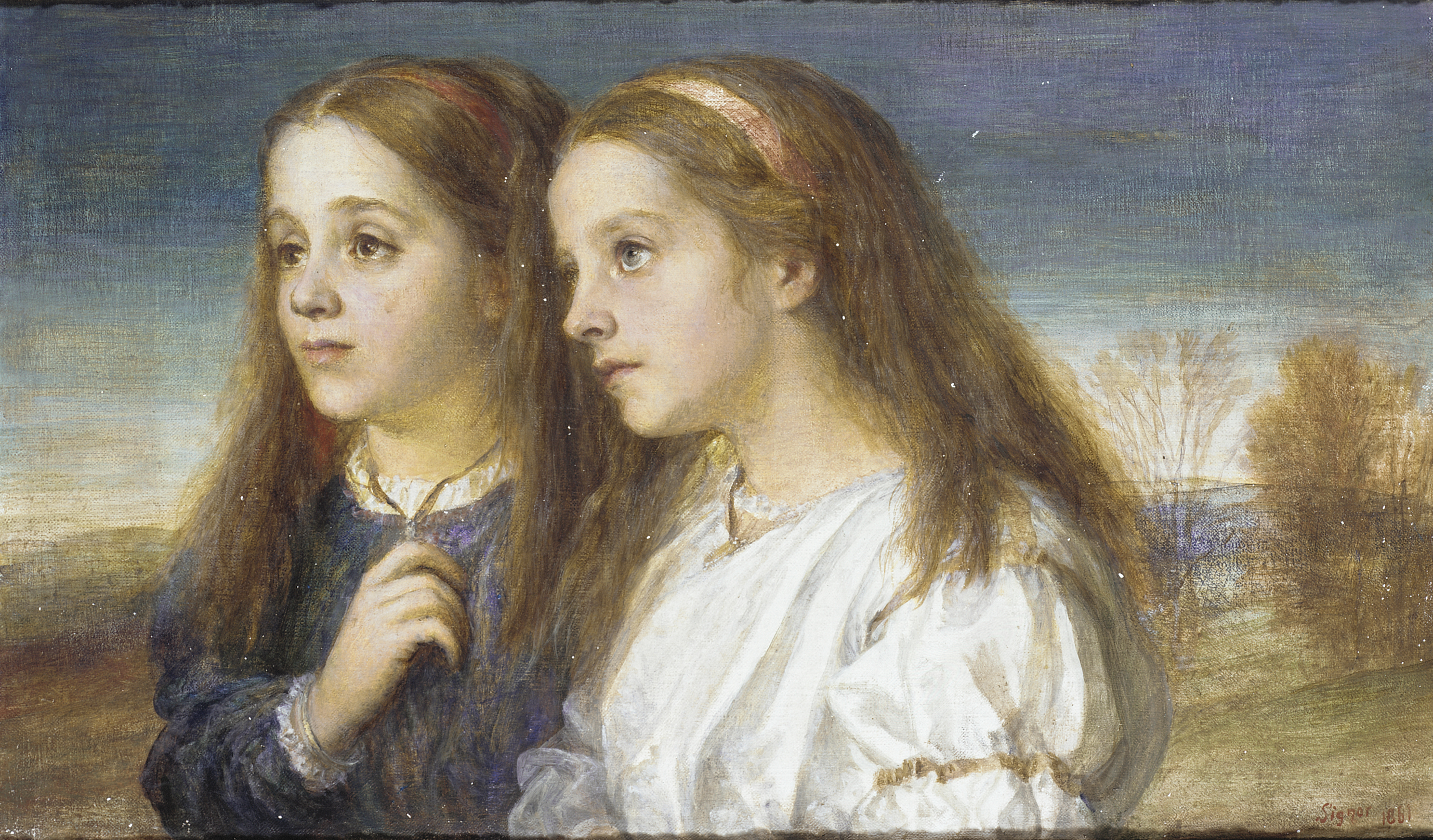
Isabel and Adeline as children, painted by G F Watts by permission of James Hervey-Bathurst, Eastnor Castle

Isabel and Adeline Somers Cocks were daughters of the 3rd Earl Somers and his beautiful and vivacious wife, Virginia. A third daughter, named Virginia after her mother, sadly died in infancy from diptheria.
The two girls had a privileged but rather cloistered childhood, often left to the care of a succession of governesses as their parents travelled widely. Their mother was so paranoid about them catching infections that she issued detailed instructions as to what they were to wear and what activities they could or could not undertake. This was all rather frustrating to the girls, although Adeline seems to have been more obiedient than the spirited Isabel.

It is therefore rather surprising to find that in later life both Isabel and Adeline chose actively to support causes which were not fashionable and which took them face to face with some of the more unsavourary aspects of Victorian life.

Isabel, better known by her married name of Lady Henry Somerset, campaigned for temperance and worked tirelessly with women and children whose lives had been blighted by alcohol abuse. She regularly went out onto the streets of London, late at night, to see for herself the social problems caused by drink and drug abuse.
Adeline, meanwhile, had married the Marquis of Tavistock, son of the Duke of Bedford. Her mother-in-law, the Duchess was so straight-laced that when Isabel sought a legal separation from her husband on the grounds of his homosexuality, she refused to associate with her. There was a farcical incident at Adeline’s home where Isabel had to flee down the backstairs so as to avoid the Duchess, who had come to visit.
But Adeline too was moved by the plight of those less fortunate than herself. She didn’t just support her sister’s causes, finacially and emotionally. She herself became Chairman of the board of Borstal Institutions and Vice-President of the Association of Lady Visitors to prisons. Like her sister, she was not just a titled figurehead. yet prison visiting was hardly a glamorous pastime for someone of her social rank.
Both sisters were deeply religious and Adeline was a very close friend of the Archbishop of Canterbury and his wife.

Having written the biography of Isabel, Lady Henry Somerset, I now plan to research the life of Adeline, as I feel this has the potential to be another so far untold story of a remarkable woman.

If anyone has any information about Adeline, i would love to hear from you.

Posted in Feminism, Lady Henry | Tagged , | 2 Comments

Finding those elusive markets for local interest books

I thought I’d cracked it when my local bookshop, Bookworms in Reigate, agreed to stock my book, “A Talent for Humanity – the life and work of Lady Henry Somerset”.Poster in window, 10 copies sold within a week and another 10 ordered … looking good, I thought.
But sadly life is tough for small independent bookshops & within a week of taking the 2nd batch of 10, the closing down notices went up. Honestly, it wasn’t my fault. In fact I suspect the interest in my book (helped by excellent publicity in the local press) kept the place open for an extra few days.
There was no other bookshop in town except Sussex Stationers, and although the local manager seemed interested, the buyer wasn’t.

Feeling a bit like one of the candidates on The Apprentice, desperate to make a sale, I touted my book round a few other local shops and was delighted when 1st Stop Stationers, in Reigate High Street, agreed to take 5 copies on a sale or return basis. They have done me proud, with the book centre stage in the window, complete with the poster I supplied.

Reading that our nearest Waterstones (in neighbouring Redhill) was also now willing to promote local authors, I took my book in and was met with a very positive response. Copies now sit in the middle of their display of local interest books, complete with favourable review written by one of the staff team. It’s a great feeling to see it there.

So be brave – if you don’t ask, you won’t get anyone to sell your book.

Tagged | Leave a comment

Book Launch at Eastnor Castle

The author awaits guests at her book launch at Eastnor Castle

I was thrilled to have a launch for my book about Lady Henry Somerset at Eastnor Castle on June 11th.
The present owner, James Hervey-Bathurst, had been most helpful during my researches, allowing me to access the archives at Eastnor. His grandfather, Arthur, was a cousin of Lady Henry’s and it was Arthur who inherited the barony and most of the Somers’ family estates from the 3rd Earl Somers.
Eastnor Castle is a splendid mock-Norman Castle built by the 1st Earl Somers, on the site of a former family home, Castleditch. Some of the earlier building is apparantly buried in the large lake at the rear of the Castle. The Earl employed the famous architect, Sir Robert Smirke, to create a property which he felt was more in keeping with his wealth and status. This had been acquired by shrewd political dealings.
The Castle is open to the public for a limited time during the summer but is well worth a visit. There are many portraits by the well-known Victorian artist, G F Watts, who was a great friend of the Somers Family. My favourites are of course those of Isabel as a child with her sister Adeline and the lovely portrait of her, shortly after her marriage to Lord Henry Somerset which I have been able to use as the cover for my book. The portraits are in the Octagon Room and are well worth close study.
Eastnor is unlike many stately homes – it does give you a feeling of being a real home. James and his family still live there. One of the added bonuses of researching in the archives there was seeing the castle in regular use today. Photo shoots for Land Rover, private parties, filming in the grounds, preparations for the Big Chill and other events in the magnificent Eastnor Park – all in a day’s work for the busy staff team.
All families have interesting and note-worthy characters. Lady Henry was by no means the only fascinating personality. Arthur, for example, went on to become Governor of Victoria, in Australia and then Chief Scout of the British Empire, succeeding Lord Baden-Powell.

Tagged , , | Leave a comment

Promoting yourself

If you want to get your message across to the big wide world, it’s no good hiding yourself away.

Don’t be modest. Shout about your successes. Put you work out where others can find you. And find you they will …

So I am assured by Tom Evans, the Bookwright, to whom I turned for help to launch myself into cyberspace. I’m not ashamed to say I needed someone to hold me hand to get me started and Tom was the right man at the right time. And I realised I was taking a leaf out of my heroine’s book. Lady Henry Somerset would always ensure she called in the experts to advise her, so she could speak and act with confidence. She was an arch manipulator of the media in her time. What would she have done with the wonders of the web at her disposal?

Within a couple of hours Tom had me blogging and twittering, spinning threads to link with others who share my interest and enthusiasms. I suddenly feel I have access to a whole new world.

A century late, I’ll be able to get some of Lady Henry’s messages out there on the internet, as proxy on her behalf. It’s what she would have done, had the toolls been available to her then.

Tagged , , | Leave a comment

Temperance doesn’t mean abstinence

Lady Henry Somerset

The temperance movement was at its height in Britain in the late 19th century. With towns awash with alcohol-induced squalor, many strong-minded women realised that curbs were needed on the liquor trade.
Some, as in America, advocated prohibition. Others, like Lady Henry Somerset, the President of the British Women’s Temperance Association, were more realistic, knowing this was never going to happen in Britain. She didn’t seriously expect everyone to stop drinking – she just advocated moderation and a system which made alcohol less readily available.
Of course, Lady Henry believed in leading by example. She herself signed the Total Abstinence Pledge, though she confessed to enjoying her last glass (or two) of port at Worcester Railway Station on her way to the very meeting where she made her pledge and encouraged all her tenants and servants to join her.
When she gave evidence to the Royal Commission on Liquor Licensing in 1897 she astounded some of its members by her moderation: “I would not wish to interfere with anybody who close to take alcohol in moderate quantities”, she said.

Posted in Temperance | Tagged , , | Leave a comment

A Talent for Humanity – the life and work of Lady Henry Somerset

Why has the world forgotten about Lady Henry Somerset? She was an amazing woman, so ahead of her time. An orator, artist, journalist, writer and social pioneer, she led the Temperance Movement in the late 19th century, advocating curbs on the liquor trade to make it less easy for people to succumb to alcohol abuse. Although she signed the total abstinence pledge herself, and encouraged her tenants and staff to do the same, she actually did not expect or demand that alcohol be banned.

As the dabate rages about whether the 24 hour drinking laws should be repealed, it is worth studying the words of Lady Henry – they are so relevant today.

Read all about her work in my new book, A Talent for Humanity – the life and work ofLady Henry Somerset, available through Amazon.

Posted in Lady Henry | Tagged | Leave a comment