
-
Recent Posts
Categories
- A Talent for Humanity
- Agnes Weston
- alcohol abuse
- Anglo-catholicism
- Army
- Band of Hope
- Basingstoke
- Bermondsey
- Bermondsey Settlement
- book reviews
- books by Ros Black
- British Women's Temperance Association
- British women's temperance movement
- Catherine Booth
- Chailey Heritage
- Chailey Heritage Foundation
- Chailey Old Scholars
- Cuckfield
- Devonport
- Duxhurst
- Duxhurst – Surrey's Lost Village
- Eastnor castle
- Elizabeth Lewis
- female temperance reformers
- Feminism
- Fight for women's suffrage
- Fr Dolling
- G.F. Watts
- Golf
- government policy on alcohol
- Grace Kimmins
- Guild of Play
- Guild of the Brave Poor Things
- International Women's Day
- Julia Wightman
- King signs pledge for duration of First world war
- Lady Henry
- Lady Henry Somerset
- Navy
- Out and About
- Plymouth
- poems
- Portsmouth
- Radio programmes
- Recreational pursuits
- rehabilitation
- Reigate Health Golf Club
- Reigate Local History
- Reigate Priory
- Reigate priory Museum
- religion
- Ritualists
- Rosalind Howard Countess of Carlisle
- Saints
- Sarah Robinson
- SCANDAL SALVATION AND SUFFRAGE
- sexual equality
- Short fiction
- short stories
- Sisters of the People
- Soldiers Friend
- Soldiers' Institute
- Somers Somerset
- St Rita
- Suffragettes
- Suffragists
- Surrey Local History
- Sussex towns and villages
- talks and book signings
- teetotalism
- Temperance
- temperance pledge
- temperance tales from Sussex
- Victorian Do-Gooders
- Victorian temperance movement
- West London Mission
- West London Mission, Sister of the People, Bermondsey Settlement, Chailey Heritage Foundation
- women of the temperance movement
- women's history
- Women's Right to Vote
- Women's Rights
- World war One
- World Woman's Christian Temperance Union
- WWI
A Talent for Humanity
Buy the book today from Amazon - signed copy also available for collectors

Temperance Tales
I am working hard on a new book which will feature the stories of several Victorian women who, in different ways, tacked the issue of alcohol abuse.
Lady Henry Somerset has led me to discover other unsung heroines and to see a different side to some women of history whom we think we know.
Watch this space.
Ros
Creativity is a state of mind
Creating something of beauty, or something better than you imagined yourself capable of creating, is extremely uplifting.
I speak from personal experience here, having recently started art classes with The Seasons Art Class. I dropped art at school when just 14, in order to pursue more “academic” subjects but I’ve frequently found myself looking at flowers or landscapes and wishing I could capture their colours, shades and contrasts. In truth I’ve always had a hankering to paint a picture I could frame and say “I did that”.
Just 4 weeks into the course, I already feel proud of what I have achieved. The course litertaure describes the class as “a life changing journey” saying to participants “you will find yourself noticing colours and shapes like you’ve never done before, you’ll be inspired by everything around you, you’ll notice the perspective of buildings and objects, the shadows and light on objects, and you’ll start thinking about how you can manifest these visions before you on paper!”
How true! I hereby apologise to everyone I’ve met in the last few weeks for staring at them to check whether their eyes really are half way down their heads (generally yes) or for raving about the spectrum of colours in blooming gardens.

Sketch of Goldhill, Shaftesbury
I’m very chuffed with this drawing, completed this week. The course has already given me confidence not to be intimidated by a challenge. And if I can do it, then anyone can.
I also find it interesting that my heroine, Lady Henry Somerset, believed in what she called “the moral effect of being able to create something of beauty” when she set up embroidery workshops at Duxhurst, her village in Surrey where inebriate women were cared for. If I can feel uplifted by my efforts, just imagine what it must have been like for a poor woman from the Victorian slums, brought low by poverty, overwork and alcohol abuse, to find herself producing delicate embroidery which was subsequently sold in West End stores. 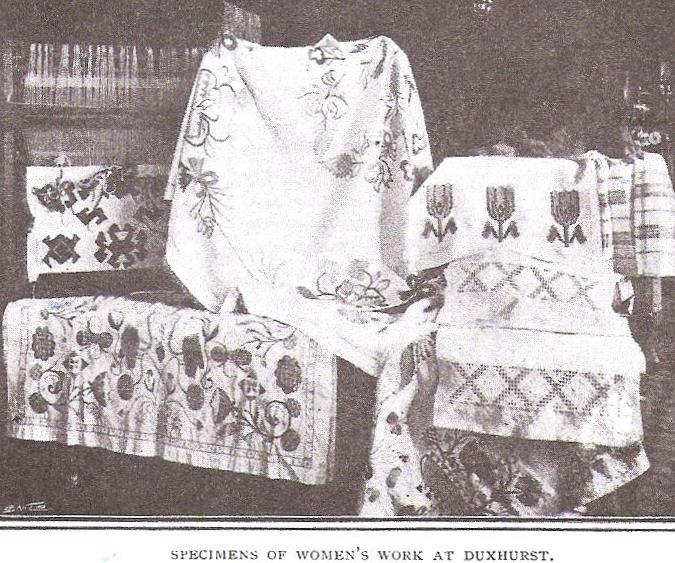
A hundred years on, creativity still works its magic on the soul.
Tenerife Sunset – a poem
TENERIFE SUNSET
Warm hues of pink,
Deepening, intense,
Spreading a roseate glow
Above the sea.
Dramatic now,
Burnished copper fronds
Radiating like an angel’s wings,
A promise of peace.
Wisps of orangey gold,
Shimmering against a purple backdrop.
The light slowly fades
To a burning glow,
Final encore of the setting sun.
The Canvas of My Youth – a reflective poem
THE CANVAS OF MY YOUTH
Curls of coal smoke hanging in the air,
Friday’s fish odour; tinned fruit with carnation cream.
Psychedelic purple, swirling through emerald green,
Carnaby Street meets Made in Yorkshire mini dress.
“I ain’t heavy …” blasting from the tranny.
(I always preferred The Hollies to the Beatles.)
Screen flickering in the corner,
The incessant din of Emmerdale or Corrie,
My mum’s escape from her humdrum life.
Dad’s geraniums crammed on window ledges,
Their scent pungent and heavy,
Stategically placed by the telephone to discourage chatter
Or a proud exhibition of his work?
The new eye shadow lurking in my bag
To be craftily applied before going out,
Hoping it wouldn’t be spotted as I slammed the door.
Sights, sounds and smells
Splattered forever on the canvas of my youth.
Posted in Out and About, poems, Recreational pursuits
Tagged carnaby street, coal smoke, reflections on youth
Leave a comment
I don’t believe in ghosts – a poem inspired by the work of Frank Dickinson, an arts and crafts pioneer who built his own home, Little Holland House in Carlshalton, Surrey
I don’t believe in ghosts,
But there’s a spirit within this place.
A sense of purpose, of achievement.
Every beam, every tile
A testimony to toil and sweat;
To a genius with vision
And the will to craft new designs,
Functionality melded with beauty.
It’s a proud man but a family man
Who can create a loving home
Within a shrine to his own artistry.
I don’t believe in ghosts,
But there’s a spirit within this place.
Pause and look around,
Every lintel, every panel carved
Or painted, to honour and celebrate
God with family.
Hand crafted chairs, deceptively simple.
A bed made without nails or screws,
Held together by a carpenter’s love.
Can you not hear the joyful music,
The beating heart of the house?
I don’t believe in ghosts,
But there’s a spirit within this place.
Talent4humanity becomes rosblackcreative
Please don’t rush away if you typed in www.talent4humanity.com and this site came up. It is one and the same but I have retitled my blog to avoid confusion with another website.
All the Lady Henry Somerset and Duxhurst village information is still here. My plan is to reorganise the blog so that all these posts are grouped together and to add to the site some of my other creative writing, including the occasional poem. Please bear with me whilst this work to the site is taking place as I’m much more creative than technical!!
You should also still be able to buy either (or both) of my books A Talent for Humanity – the life and work of Lady Henry Somerset and Duxhurst – Surrey’s Lost Village through the site but if you encounter any problems please send me an email ros243@sky.com
I hope you enjoy browsing. Thank you for your patience.
International Women’s Day – I’d nominate Lady Henry Somerset as a forgotten heroine of social reform
As we celebrate the achievements of women around the world, on International Women’s Day, we should not forget the pioneers of women’s rights in Victorian times. We all remember the suffragettes but there were thousands more women who actively campaigned for women’s suffrage without resorting to physical violence or drastic measures.
Lady Henry Somerset was one such person.

Her social status and position as President of the British Women’s Temperance Association gave her a platform to promote all women’s issues. She used it very effectively. Her view was that women were very skilled at running the home, in many cases managing the family finances and caring for others, and these were skills which the country as a whole needed. She proved that women could manage big organisations, run newspapers and create a truly international movement – the World Woman’s Christian Temperance Union. Her oratory was reknown throughout Britain and America, where she addressed crowds of several thousands.
She had a big following amongst the working class women. She was far more than a “Lady Bountiful”. She really believed in making a difference and appreciated that it was often the small things which mattered most to people. She also understood it was better to help people to help themselves than just to hand out money.
 rosblackcreative